Why Commercial Boiler Installation Is One of the Most Critical Decisions for Your Business
Commercial boiler installation is the process of selecting, positioning, connecting, and commissioning a high-capacity heating system in a business or commercial facility. Here is a quick overview of what it involves:
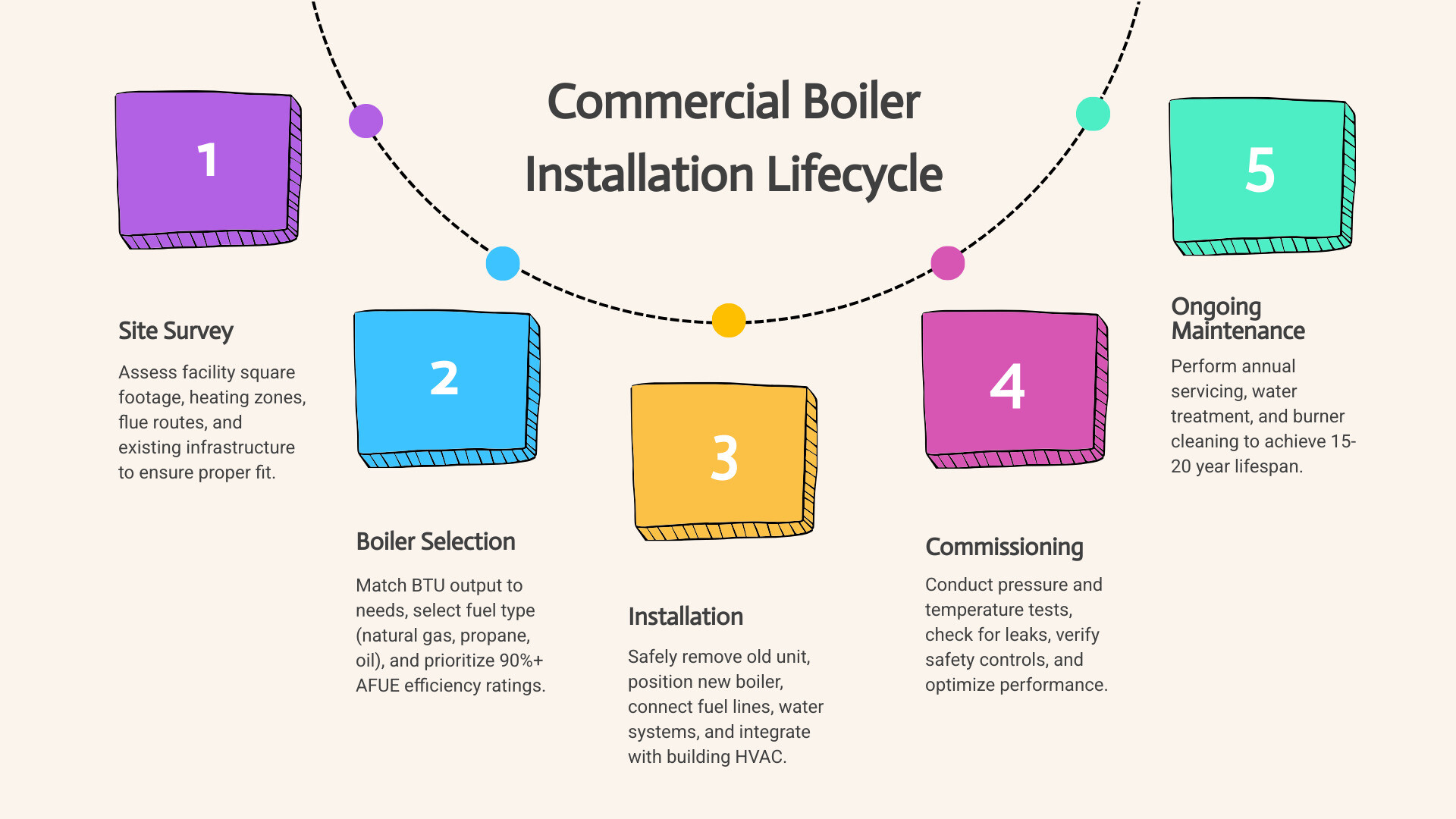
- Site survey – Assess your facility’s size, heating zones, and infrastructure
- Boiler selection – Match capacity (BTUs), fuel type, and efficiency rating to your needs
- Installation – Remove old unit, position new boiler, connect fuel and heating systems
- Commissioning – Test pressure, check for leaks, verify safety controls
- Ongoing maintenance – Annual servicing to protect your investment and extend lifespan
Few decisions affect your building’s comfort, safety, and operating costs more than getting this right.
Your heating system is not just a utility – it is the backbone of your operation. Whether you run a school, a medical facility, or a multi-unit property, a failed boiler means lost productivity, unhappy occupants, and costly emergency repairs. And with commercial boilers ranging from 200,000 BTUs all the way past 1,000,000 BTUs, the stakes of choosing or installing the wrong system are high.
This guide walks you through everything you need to know – from picking the right system to keeping it running for 15 to 20 years.
I’m Richard Marcello, President of Advanced Heating & Cooling, and I’ve spent over 30 years overseeing commercial boiler installation projects across Rhode Island and Massachusetts. My team and I have seen what separates a smooth, long-lasting installation from one that causes headaches for years.
Understanding Commercial Boiler Systems and Types
When we talk about Commercial boiler installation, we aren’t just talking about a bigger version of the unit in your basement. Commercial systems are industrial-grade machines designed to provide heat for large-scale spaces or high-demand processes. Understanding the different types available is the first step in ensuring your facility remains “full steam ahead.”
Steam Boilers
Steam boilers are the heavy hitters of the industry. They work by heating water until it turns into steam, which is then piped through the building. You’ll often find these in older Rhode Island buildings or industrial manufacturing plants where high-pressure steam is required for specific processes. While powerful, they require precise pressure management and specialized maintenance to prevent scaling.
Hot Water Systems
These are more common in modern office buildings, retail spaces, and healthcare facilities. Instead of turning water into steam, they heat water to a specific temperature (usually between 160°F and 180°F) and circulate it through radiators, baseboards, or underfloor heating loops. They are generally easier to maintain and offer excellent comfort control.
Condensing Technology
If you’re looking to slash your energy bills, condensing boilers are the gold standard. Traditional boilers lose a significant amount of heat through the flue gases. Condensing units use a larger heat exchanger to extract that “waste” heat from the exhaust, turning water vapor back into liquid (condensate). This process makes them incredibly efficient.
Fire-Tube vs. Water-Tube
This refers to how the boiler actually transfers heat:
- Fire-Tube Boilers: Hot combustion gases pass through tubes surrounded by water. They are robust, handle fluctuating loads well, and are often easier to clean.
- Water-Tube Boilers: Water circulates inside tubes that are surrounded by hot gases. These are typically used for very high-pressure applications because they can generate steam much faster than fire-tube models.
| Boiler Type | Primary Application | Key Benefit |
|---|---|---|
| Steam | Industrial plants, hospitals | High heat carrying capacity |
| Hot Water | Schools, offices, retail | Consistent comfort, lower maintenance |
| Condensing | Eco-conscious businesses | Maximum energy efficiency (90%+ AFUE) |
| Electric | Sites without gas lines | Zero local emissions, compact |
For more information on how these systems integrate with your overall building strategy, check out our commercial HVAC services.
Key Differences Between Residential and Commercial Units
The jump from residential to commercial is significant. While a residential boiler might top out at 100,000 to 150,000 BTUs (British Thermal Units), Commercial boiler installation projects typically deal with units starting at 200,000 BTUs and climbing well over 1,000,000 BTUs.
Beyond just raw power, the scale of operation is different. Commercial units often feature:
- Complex Control Systems: These allow the boiler to communicate with building management systems (BMS) for remote monitoring.
- Redundancy: Many commercial setups use a “lead-lag” system where multiple smaller boilers work together. If one fails, the others take over, ensuring the building never goes cold.
- Regulatory Rigor: Commercial units must meet much stricter safety and emissions standards than residential models.
Planning Your Commercial Boiler Installation
You wouldn’t buy a suit without getting measured, and you shouldn’t buy a boiler without a professional heat loss calculation. Planning is where we save you the most money in the long run.
Heat Loss Calculation and Sizing
One of the most common mistakes in Commercial boiler installation is “oversizing.” Many people assume that a bigger boiler is always better. In reality, a boiler that is too large for the space will “short cycle”—turning on and off rapidly. This wastes fuel, puts immense strain on the components, and leads to a premature death for the unit.
We look at your facility’s square footage, the quality of your insulation, the type of windows you have, and even the local climate in areas like Smithfield or Johnston to determine the exact BTU requirement.
Fuel Type Selection
Your choice of fuel significantly impacts your operating costs.
- Natural Gas: Currently the most popular choice due to its balance of cost and efficiency (approx. 4p per kWh in running costs).
- Electric: While the units are often cheaper to install and require no venting, the running costs can be much higher (approx. 15p per kWh).
- Oil: Common in some rural parts of Rhode Island, though many businesses are retrofitting to gas for better efficiency.
Understanding AFUE Ratings
The Annual Fuel Utilization Efficiency (AFUE) rating tells you how much of the fuel you pay for actually turns into heat. A boiler with an 80% AFUE loses 20% of its energy up the chimney. Modern high-efficiency models boast AFUE ratings of 90% or higher, which can lead to massive savings over the 15-to-20-year lifespan of the system.
Selecting the Right Unit for Commercial Boiler Installation
When selecting a unit, we prioritize high-efficiency models with high modulation ratios. Modulation allows the boiler to “throttle down” its output. If it’s a mild day in North Smithfield, your boiler doesn’t need to run at 100% capacity. A high modulation ratio allows it to run at, say, 10% capacity, using only the fuel necessary to maintain the temperature.
Brand reliability is also key. We look for manufacturers with a strong history of parts availability and local support. You can learn more about our approach to high-performance systems on our page about efficient-and-reliable-commercial-hvac-services-in-smithfield-ri.
The Step-by-Step Commercial Boiler Installation Process
A successful installation is a choreographed dance. Here is how we handle the process at Advanced Heating & Cooling to ensure your business experiences as little disruption as possible.
1. Detailed Site Survey
Before a single wrench is turned, we walk the plant room. We check flue routes, ensure there is a drain nearby for condensate (essential for condensing boilers), and verify that the floor can handle the weight of the new unit. We also look at the “clearances”—the space required around the boiler for future servicing.
2. Minimizing Downtime
We know that for a business, “time is money.” To minimize heating downtime, we often pre-assemble as much of the pipework as possible. In some cases, we can position the new boiler while the old one is still running, allowing us to switch over the connections in as little as 30 minutes to an hour.
3. Old Unit Removal
Removing a massive commercial boiler is no small feat. We handle the decommissioning, ensuring all fuel lines are safely capped and hazardous materials (like old asbestos insulation in very old buildings) are handled according to strict environmental protocols.
4. System Integration
Once the new unit is in place, we connect it to your existing infrastructure. This includes:
- Gas/Fuel Lines: Ensuring leak-free, high-pressure connections.
- Electrical: Updating wiring to handle modern control systems.
- Ductwork and Piping: Integrating with your radiators or air handlers.
5. Commissioning
This is the most critical step. We don’t just turn it on and leave. Commissioning involves testing the boiler against the manufacturer’s specific guidelines. We check gas pressure, verify the safety shut-offs, and conduct a combustion analysis to ensure the unit is burning fuel as cleanly as possible. For a deeper dive into managing this transition, see our business owner’s guide to seamless replacement.
Safety and Compliance in Commercial Boiler Installation
In commercial heating, safety isn’t optional—it’s the law. Commercial boiler installation must adhere to local building codes and national safety standards.
- Permits: We handle the filing of all necessary permits with the local municipality (whether you’re in Smithfield, North Smithfield, or Johnston).
- Ventilation: Proper venting is vital to prevent the buildup of carbon monoxide (CO). We install CO detectors and ensure that the flue system is perfectly sealed.
- Pressure Testing: Every connection is pressure-tested to ensure there are no leaks that could lead to fire hazards or system failure.
- Gas Safe Standards: Only professionals with specific commercial certifications should ever touch these units. An improper installation can lead to gas leaks, explosions, or carbon monoxide poisoning.
Maximizing ROI and Longevity Post-Installation
A new commercial boiler is a significant investment. With proper care, these units typically last 15 to 20 years. Some high-quality models, like those from JLA, are built to last even longer with continuous use.
Annual Maintenance: The Key to 20 Years
Think of annual maintenance as an insurance policy. During a yearly tune-up, we:
- Clean the Burners: Ensuring a blue, efficient flame (a yellow flame is a major red flag).
- Water Treatment: Commercial systems use a lot of water. Without treatment, minerals will build up (scaling), which acts as an insulator and forces the boiler to work harder, eventually cracking the heat exchanger.
- Inspect Safety Controls: We test the low-water cutoffs and pressure relief valves to ensure they will work in an emergency.
Regular servicing helps diagnose small issues before they become $10,000 breakdowns. You can find more details on our heating installation and repair page.
Signs Your Current System Needs Replacement
How do you know it’s time to stop repairing and start replacing? Look for these “red flags”:
- The 15-Year Mark: If your boiler is over 15 years old, its efficiency has likely dropped significantly. Modern units are often 20-30% more efficient than those from the early 2000s.
- Yellow Flame: This indicates incomplete combustion and the presence of carbon monoxide. It is a serious safety risk.
- Frequent Repairs: If you’re calling us more than once a year for repairs, those costs are better spent on a new, warrantied unit.
- Visible Leaks: Leaks from seals or valves often indicate that the internal pressure or corrosion has reached a breaking point.
- Rising Fuel Costs: If your heating bills are climbing but your usage hasn’t changed, your boiler is likely struggling to keep up.
If you’re seeing these signs, it may be time to look into a new heating installation.
Frequently Asked Questions about Commercial Boiler Installation
How long does a typical installation take?
The timeline for Commercial boiler installation varies based on complexity. A straightforward replacement can take as little as 0.5 to 1 day. However, a large-scale system upgrade involving new pipework, multiple units, or complex control integration can take 2 to 3 days. We always provide a detailed timeline during our initial consultation to help you plan for minimal business disruption.
What factors influence the total cost of installation?
Several variables affect the final quote:
- Boiler Size and Capacity: A 1,000,000 BTU unit costs more than a 200,000 BTU unit.
- Efficiency Rating: High-efficiency condensing boilers have a higher upfront cost but lower long-term operating costs.
- Labor and Infrastructure: If we need to upgrade your gas lines or flue system to meet modern codes, that will influence the labor cost.
- System Upgrades: Including new pumps, heat exchangers, or smart controls will add to the initial investment but improve overall system performance.
Why is professional commissioning necessary?
Commissioning is the “final exam” for your boiler. It is necessary for three reasons:
- Warranty: Most manufacturers will void your warranty if the system wasn’t commissioned by a certified professional.
- Safety: It verifies that all emergency shut-offs and pressure valves are functioning correctly.
- Performance: It ensures the boiler is configured for your specific building’s needs, maximizing energy savings from day one.
Conclusion
At Advanced Heating & Cooling, we believe that a Commercial boiler installation should be a “set it and forget it” experience for you. With over 30 years of experience serving Smithfield, RI, and the surrounding communities—including North Smithfield, Johnston, Greenville, and beyond—we pride ourselves on honest, quality workmanship.
We understand the unique needs of Rhode Island businesses, from the historic buildings in Stillwater to the modern facilities in Esmond. Whether you need a high-pressure steam system for a production plant or a high-efficiency condensing boiler for a retail space, our team is ready to deliver a turnkey solution that keeps your facility warm and your energy bills low.
Don’t wait for a mid-winter breakdown to start thinking about your heating system. We offer free estimates and expert consultations to help you find the perfect fit for your building.
Schedule your professional heating installation today with the experts at Advanced Heating & Cooling.