

Understanding the True Investment in Commercial HVAC Systems
Commercial HVAC replacement cost is a significant investment that directly impacts your business operations, employee comfort, and bottom line. Whether you’re replacing an aging system or planning a strategic upgrade, understanding the full scope of expenses is crucial for accurate budgeting.
Quick Cost Overview:
- Small Office Buildings (2,000-5,000 sq ft): $15,000 – $30,000
- Retail Stores & Restaurants: $20,000 – $40,000
- Warehouses & Industrial Facilities: $25,000 – $45,000+
- Large Office Buildings: $28,000 – $50,000+
- Cost per Square Foot: $15 – $33 (varies by building type)
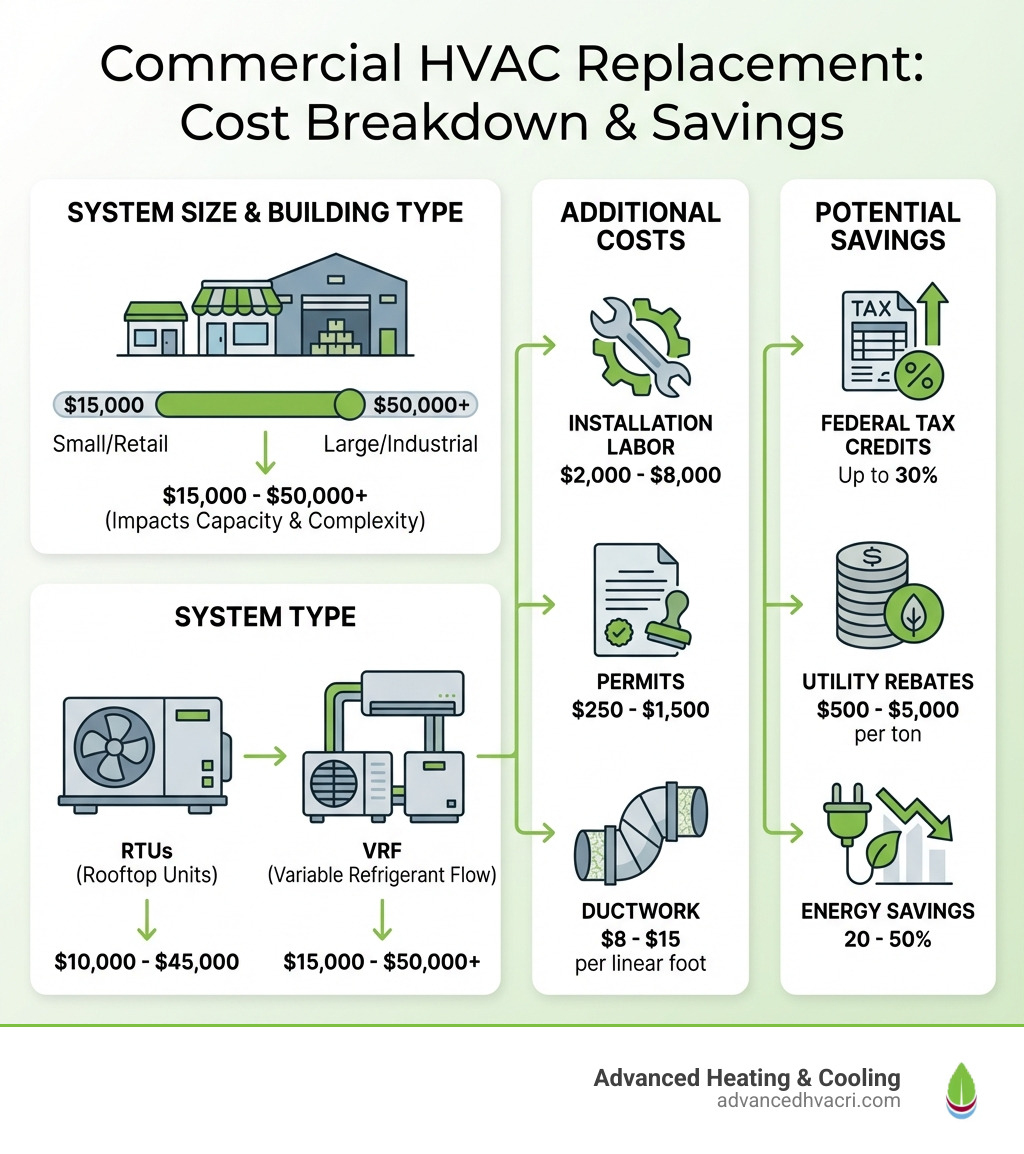
The final price depends on multiple factors: system size, unit type, installation complexity, ductwork needs, permits, and local regulations. Additional costs for labor, equipment removal, and infrastructure modifications can add thousands to your total investment.
Business owners often face frustration when they find that the initial quote for a new unit is just the starting point. Hidden expenses like rooftop installation labor, electrical upgrades, and ductwork modifications can quickly inflate the budget. The good news? With proper planning and understanding of what drives these costs, you can make informed decisions that balance upfront investment with long-term value.
Modern commercial HVAC systems offer substantial benefits beyond basic heating and cooling. New systems featuring smart controls and AI-powered optimization can reduce energy costs by 20-40% compared to older units. Variable Refrigerant Flow (VRF) systems deliver energy savings of 30-50%, while geothermal systems can achieve savings of 50-70%. These efficiency gains often offset the higher initial investment within a few years.
I’m Richard Marcello, President of Advanced Heating & Cooling, with over 30 years of hands-on experience serving businesses throughout Rhode Island and nearby Massachusetts. Throughout my career, I’ve helped countless business owners steer Commercial HVAC replacement cost decisions, ensuring they get reliable systems that meet their needs without unnecessary expense.
Key Factors Influencing Your Commercial HVAC Replacement Cost
When we talk about commercial HVAC replacement, we’re not just swapping out a box. We’re dealing with complex systems custom to specific building requirements and energy needs. The larger scale and specialized nature of commercial HVAC mean that replacement costs are influenced by a unique set of factors compared to residential installations. Understanding these elements is the first step toward accurate budgeting and a successful upgrade. For more information on various commercial systems, you can always check out our resources on commercial systems.
System Size, Capacity, and Building Type

The most significant factor determining your commercial HVAC replacement cost will always be the size and type of your premises. A small office in Smithfield, RI, will have vastly different heating and cooling requirements than a large warehouse in Johnston or a busy restaurant in Greenville. Commercial HVAC systems are measured in “tons” of refrigeration, a unit representing cooling capacity. To properly size a system, we often use calculations based on square footage, but other factors like ceiling height, window exposure, occupancy, and heat-generating equipment (think kitchen appliances or server rooms) also play a crucial role.
A common way to estimate BTUs (British Thermal Units) needed is to divide the building’s square footage by 500, then multiply by 12,000. However, this is a rough estimate. A professional load calculation is essential to avoid improper sizing. Why? An oversized unit will cycle too frequently (short cycling), leading to increased energy consumption (up to 15-30% more), reduced equipment lifespan, and poor humidity control. Conversely, an undersized unit won’t be able to keep up with demand, resulting in inconsistent temperatures and discomfort.
Here’s a general breakdown of typical costs per square foot, based on building type:
- Small Office Buildings (2,000-5,000 sq ft): Expect to pay around $20 – $28 per square foot, with total costs ranging from $15,000 – $30,000.
- Large Office Buildings: These can be more complex, costing $28 – $33 per square foot, leading to total investments of $28,000 – $50,000+.
- Retail Stores & Restaurants: With higher occupancy and heat loads, these generally fall between $20,000 – $40,000 for replacement.
- Warehouses & Industrial Facilities: Costs here range from $15 – $25 per square foot, with total projects often between $25,000 – $45,000+.
- Sports & Recreational Buildings: Due to large open spaces and varying occupancy, these can cost $22 – $27 per square foot.
How Different System Types Affect Commercial HVAC Replacement Cost
The type of commercial HVAC system you choose significantly impacts both the upfront replacement cost and your long-term operating expenses. Each system has its strengths, making it suitable for different business needs and building layouts across our service areas like North Smithfield or Mapleville.
Here’s a comparison of common commercial HVAC system types:
| System Type | Typical Cost Range | Best Use Case | Energy Efficiency (Compared to Traditional) |
|---|---|---|---|
| Packaged Rooftop Units (RTUs) | $10,000 – $45,000 | Most common for commercial, single-zone cooling/heating. Retail, offices, warehouses with rooftop access. | Moderate to High (with modern units) |
| Split Systems | $7,000 – $40,000 | Smaller commercial spaces, zoned applications, where indoor and outdoor units are separated. | Moderate to High |
| Variable Refrigerant Flow (VRF) | $15,000 – $50,000+ | Multi-zone buildings (hotels, medical facilities, large offices) needing simultaneous heating/cooling in different areas. | Very High (30-50% energy savings) |
| Ductless Multi-Zone Systems | $8,000 – $35,000 | Office retrofits, specific zones, or buildings where ductwork installation is difficult or expensive. | High |
| Geothermal Systems | $20,000 – $80,000+ | Businesses with consistent year-round HVAC needs and adequate land for ground loops. Large offices, retail centers. | Extremely High (50-70% energy savings) |
| Chilled Water Systems | $20,000 – over $100,000 | Very large commercial or industrial facilities, campuses, manufacturing plants. | High (for large-scale applications) |
Geothermal systems, while having a higher upfront cost, offer remarkable energy savings (50-70%) and an impressive lifespan of 25-50 years. They are a long-term investment that can pay back within 3-7 years, especially valuable for businesses in areas like Woodville or Stillwater with stable ground temperatures.
Climate, Location, and Government Regulations
The climate in our region of Smithfield, RI, and surrounding towns like Forestdale or Slaterville, significantly influences the type and capacity of the HVAC system needed. We experience distinct heating and cooling seasons, meaning your commercial HVAC system must be robust enough to handle both the humid summers and cold winters effectively. A business in a hotter climate might prioritize cooling capacity, while we need a balanced system designed for year-round performance. This directly impacts the unit’s specifications and, consequently, its cost.
Beyond local climate, government regulations play an increasingly critical role in commercial HVAC replacement cost. The U.S. Environmental Protection Agency (EPA) has been implementing regulations to phase out refrigerants with high global warming potential. Here’s what’s important for 2025:
- R-22 Ban: R-22, an ozone-depleting refrigerant, has been completely banned. If your existing system uses R-22, finding refrigerant for repairs is difficult and expensive. This makes replacement a more viable and often necessary option.
- R-410A Phase-Out: As of 2025, R-410A is being eliminated from new commercial systems. While not banned for existing systems, its availability will decrease, and costs will likely rise.
- New Eco-Friendly Refrigerants: New systems are transitioning to lower Global Warming Potential (GWP) refrigerants like R-32 and R-454B. These newer refrigerants often require systems designed specifically for them, meaning older units cannot simply be refitted.
These regulations mean that replacing an older system isn’t just about efficiency; it’s about compliance and future-proofing your business. Newer systems are designed to meet stringent energy efficiency standards, which, while sometimes increasing upfront costs, lead to substantial long-term savings on your energy bills.
Beyond the Unit: Uncovering Additional Replacement Costs
When budgeting for a commercial HVAC replacement cost, it’s easy to focus solely on the price of the new unit. However, a comprehensive budget needs to account for what we call “hidden expenses”—the costs associated with labor, permits, disposal, and necessary infrastructure modifications. These can significantly impact the overall project scope and final price tag. Ignoring them can lead to unexpected financial strain.
Labor, Permits, and Installation Complexity
Commercial HVAC installations are intricate projects that demand specialized skills and often a larger workforce than residential jobs.
- Installation Labor Rates: In our region, commercial HVAC labor rates typically range from $75 to $150 per hour. The complexity of the installation, the type of system, and the accessibility of the installation site all influence the total labor cost.
- Rooftop Installation: Many commercial buildings in Smithfield, RI, use rooftop units (RTUs). While efficient for space, installing or replacing these units often requires specialized equipment. We might need to rent a crane to safely lift the old unit off and place the new one, which can add an extra $1,000 – $3,000 to the cost. This also includes the specialized equipment fees for rigging and safety.
- Building Permits and Compliance Inspections: Before any major HVAC work can begin, we must secure the necessary building permits from local authorities in Smithfield, RI, or surrounding towns like Georgiaville or Esmond. These permits, which can cost anywhere from $250 to $1,500, ensure that the installation complies with all local building codes and safety regulations. After installation, compliance inspections (ranging from $200 to $800) are required to verify the work meets standards.
- Electrical Upgrades: Newer, more powerful, or different types of HVAC systems may require electrical upgrades to handle the increased load. This can involve new wiring, circuit breakers, or even an upgraded electrical panel, adding $1,500 – $5,000 to your budget.
- Control System Integration: If you’re upgrading to a smart HVAC system with advanced controls, integrating these into your building management system can add $2,000 – $10,000.
Ductwork, Disposal, and Infrastructure
Often, the existing infrastructure needs attention during a commercial HVAC replacement, impacting the overall commercial HVAC replacement cost.
- Ductwork Modification or Replacement: Your existing ductwork might not be suitable for a new, more efficient system, especially if you’re changing system types or capacities. New commercial ductwork typically costs $8 – $15 per linear foot. Modifications to existing ductwork can range from $2,000 – $8,000, depending on the extent of the changes. If your ducts are old, leaky, or improperly sized, replacing or upgrading them is a smart investment for optimal performance and air quality.
- Old Unit Removal and Disposal: Getting rid of the old unit isn’t as simple as tossing it in a dumpster. Removal and disposal costs typically range from $500 – $2,000. If your old system contains refrigerants like the banned R-22, specialized refrigerant recovery ($200 – $800) is legally required to prevent environmental harm.
- Asbestos Abatement: For older commercial buildings in our service area, there’s a possibility of encountering asbestos during demolition or modification of existing structures. If asbestos is present, professional abatement is legally required and can be a significant unexpected expense, potentially adding $1,000 – $5,000 for hazardous material handling, or $5 – $20 per square foot.
- Roof Curb Modifications: If your new rooftop unit doesn’t perfectly match the footprint of the old one, we might need to modify the roof curb. This ensures a watertight seal and proper support, preventing future leaks or structural issues. These modifications can cost $1,000 – $5,000.
- Insulation Upgrades: Improving insulation around ductwork ($3 – $8 per square foot of ductwork) or in other parts of the building can significantly improve the efficiency of your new HVAC system, potentially decreasing heating and cooling costs by 10-15%.
Why and When to Upgrade Your Commercial HVAC System
Deciding to replace your commercial HVAC system is a strategic business decision, not just a reactive expense. While the commercial HVAC replacement cost can seem daunting, a proactive upgrade often yields a significant return on investment (ROI) through reduced operating costs, improved comfort, and improved productivity.
Telltale Signs Your System Needs an Upgrade
There are clear indicators that your commercial HVAC system is nearing the end of its useful life and that an upgrade is warranted:
- System Age (15+ years): Most commercial HVAC systems are designed to last 15 to 25 years. If your system is consistently over 10-15 years old, its efficiency has likely declined significantly, and it’s operating on borrowed time.
- Frequent Repairs: Are you calling for repairs more often? If the cost of repairs approaches 50% of the price of a new system, or if the repair cost multiplied by the system’s age exceeds $5,000, it’s a strong signal to replace.
- Rising Energy Bills: An old, inefficient system will consume more energy to achieve the same heating or cooling, leading to noticeably higher utility bills. This is often the most compelling financial argument for an upgrade.
- Inconsistent Temperatures: If some areas of your building are too hot while others are too cold, your system might be struggling to keep up, or it could be improperly sized. This leads to discomfort for employees and customers.
- Poor Indoor Air Quality: Older systems often lack advanced filtration capabilities, leading to increased dust, allergens, and stale air. This can impact employee health and productivity.
- Unusual Noises or Odors: Grinding, banging, squealing, or persistent musty odors coming from your HVAC system are signs of mechanical issues or potential mold growth, indicating it’s time for a professional assessment.
The Long-Term Benefits of Investing in Modern Technology
Investing in a new, energy-efficient commercial HVAC system offers far more than just consistent temperatures. It’s an investment in your business’s future, providing both immediate and long-term benefits that often outweigh the initial commercial HVAC replacement cost.
- Significant Energy Savings: Modern systems are designed for peak efficiency. We’ve seen businesses in Smithfield, RI, achieve substantial reductions in their utility bills. Newer systems with AI-powered controls and smart building integration can reduce energy costs by 20-40% compared to older units. VRF systems offer 30-50% energy savings, and geothermal systems can deliver an impressive 50-70% reduction. These savings quickly add up, often leading to a relatively short payback period for your investment.
- Higher SEER Ratings: The Seasonal Energy Efficiency Ratio (SEER) measures cooling efficiency. Newer units boast much higher SEER ratings, meaning they consume less energy to provide the same amount of cooling. While higher SEER units may cost more upfront, their long-term energy savings make them a wise choice.
- Smart Controls and AI-Powered Optimization: Today’s commercial HVAC systems come with sophisticated controls that allow for precise temperature management, scheduling, and remote access. AI-powered optimization learns your building’s patterns and adjusts settings for maximum efficiency, minimizing wasted energy.
- Improved Employee Comfort and Productivity: A comfortable work environment directly impacts employee morale and productivity. Consistent temperatures, proper humidity levels, and improved indoor air quality (thanks to better filtration in new systems) create a healthier and more pleasant space for your team.
- Improved Customer Experience: For retail and hospitality businesses, a comfortable environment is crucial for customer satisfaction. A modern HVAC system ensures your clients have a positive experience, encouraging them to stay longer and return.
- Advanced Zone Control: Many newer systems, especially VRF and ductless multi-zone options, offer precise zone control. This means you can heat or cool different areas of your building to different temperatures simultaneously, preventing energy waste in unoccupied spaces. This is particularly beneficial for office buildings, and you can learn more about it on our Commercial Zone Control for Office Buildings page.
Smart Strategies to Reduce Your Overall Investment
While the commercial HVAC replacement cost is a significant expenditure, there are smart strategies we can employ to help reduce your overall investment and maximize value. It’s all about strategic planning and leveraging available resources.
Leveraging Rebates, Tax Credits, and Financing
Don’t let the upfront cost deter you. There are numerous programs designed to make energy-efficient HVAC upgrades more affordable:
- Federal Tax Credits: Many qualifying high-efficiency commercial HVAC systems are eligible for federal tax credits, which can cover up to 30% of the installation cost. We always help our clients identify if their chosen system qualifies.
- State and Local Incentives: Rhode Island, like many states, offers various incentives for energy-efficient upgrades. We encourage you to check the Database of State Incentives for Renewables & Efficiency (DSIRE) for specific programs available in Smithfield, RI, and surrounding areas. For example, heat pumps may qualify for Clean Heat Rhode Island and Rhode Island Energy rebates.
- Utility Rebates: Many local utility companies offer rebates for installing energy-efficient HVAC equipment. The Energy Star rebate finder is an excellent resource to find available utility rebates, which can range from $500 to $5,000 per ton installed.
- Manufacturer Promotions: Keep an eye out for seasonal promotions or rebates directly from HVAC manufacturers.
- Equipment Financing Options: For businesses, there are specialized financing solutions such as equipment financing (with rates as low as 4-7%), Energy Service Company (ESCO) programs, Power Purchase Agreements (PPAs), and leasing options. These can help spread the commercial HVAC replacement cost over time, preserving your working capital.
Strategic Planning and Professional Consultation
Careful planning can lead to significant savings and a smoother installation process.
- Off-Season Installation: If your business can manage it, consider scheduling your HVAC replacement during the spring or fall. HVAC contractors in our Smithfield, RI, service area are typically less busy during these shoulder seasons, which can sometimes lead to more competitive pricing – potentially saving you 10-15% on installation costs.
- Getting Multiple Quotes: Always obtain at least three detailed estimates from reputable commercial HVAC contractors. This allows you to compare not just the price, but also the scope of work, proposed equipment, and warranties. Be wary of unusually low bids, as they may cut corners or have hidden costs.
- Professional Load Calculations: As we discussed, proper sizing is paramount. Insist on a professional load calculation that considers all aspects of your building. This ensures your new system is perfectly matched to your needs, maximizing efficiency and comfort while avoiding costly errors.
- Choosing a Qualified Contractor: This is perhaps the most critical step. Look for contractors who are NATE-certified, licensed, insured, and have extensive experience with commercial HVAC systems, especially in our local climate. We at Advanced Heating & Cooling bring over 30 years of experience to every project, ensuring honest, quality workmanship. For expert advice and service, explore our commercial AC & heating services.
Conclusion
Navigating the commercial HVAC replacement cost can feel like a complex journey, but with the right knowledge and a trusted partner, it doesn’t have to be. We’ve explored the primary factors influencing these costs, from system size and type to crucial additional expenses like labor, permits, and ductwork modifications. We’ve also highlighted the compelling reasons to upgrade, focusing on the long-term benefits of modern, energy-efficient technology and the significant savings it can bring.
Replacing your commercial HVAC system is a strategic investment in your business’s operational efficiency, employee well-being, and customer satisfaction. By understanding the true costs, leveraging available incentives, and planning strategically, you can transform this necessary expenditure into a powerful asset.
At Advanced Heating & Cooling, we pride ourselves on being that trusted partner for businesses across Smithfield, RI, and our neighboring communities like Cumberland, Johnston, and North Smithfield. With over three decades of local experience, we’re committed to providing transparent, high-quality solutions that meet your unique commercial needs.
For a detailed assessment and a free estimate on your commercial HVAC replacement in the Smithfield, RI area, explore our efficient and reliable commercial HVAC services. Let us help you make an informed decision that will benefit your business for years to come.


