Why a Commercial Cool Air Conditioner Heater Might Be the Right Fit for Your Space
Commercial Cool air conditioner heater units are portable, all-in-one climate control devices that both cool and heat a room without permanent installation. Here’s a quick look at the top models to help you decide fast:
| Model | BTU (DOE SACC) | BTU (ASHRAE) | Room Coverage | Price (approx.) |
|---|---|---|---|---|
| CPT10HWB | 10,000 BTU | 14,000 BTU | Up to 700 sq. ft. | ~$390-$473 |
| CPT08HWB | 8,000 BTU | N/A listed | Up to 550 sq. ft. | ~$412 |
These units are best for:
- Renters who can’t install permanent HVAC
- Small offices or rooms up to 700 sq. ft.
- Supplemental heating or cooling in spaces your main system can’t reach
- Flexible, portable use across different rooms or locations
Year-round comfort from a single portable unit sounds appealing — and for the right situation, it genuinely delivers. But knowing which model fits your space, and whether a portable unit even makes sense over a more permanent solution, takes a bit more digging.
I’m Richard Marcello, President of Advanced Heating & Cooling, and with over 30 years of hands-on HVAC experience serving homeowners and businesses across Rhode Island, I’ve helped countless customers figure out when a commercial cool air conditioner heater makes sense — and when a more robust system is the smarter investment. Let’s walk through everything you need to know.
Basic commercial cool air conditioner heater terms:
Understanding the Commercial Cool Air Conditioner Heater Lineup
When you’re browsing for a commercial cool air conditioner heater, you’ll notice a few specific models that dominate the market. These units are designed to bridge the gap between a standard fan and a full-blown central HVAC system. In our experience at Advanced Heating & Cooling, the two heavy hitters in this lineup are the CPT10HWB and the CPT08HWB.
The Model CPT10HWB is the powerhouse of the group. It carries a 10,000 BTU SACC (Seasonally Adjusted Cooling Capacity) rating, which is the modern Department of Energy standard. Under the older ASHRAE 128 standards, this same unit is marketed as a 14,000 BTU system. Don’t let the two numbers confuse you; they refer to the same cooling power, just measured differently. This model is generally recommended for rooms up to 700 square feet, making it ideal for larger master bedrooms or small commercial office suites in Smithfield or Johnston.
The Model CPT08HWB is a slightly more compact sibling. With an 8,000 BTU DOE rating, it’s designed for spaces up to 550 square feet. It’s a fantastic choice for those “in-between” rooms that never seem to stay the right temperature, like a finished attic or a small retail storefront.
Below is a quick comparison table to help you visualize the differences:
| Specification | CPT10HWB | CPT08HWB |
|---|---|---|
| Cooling Capacity (DOE SACC) | 10,000 BTU | 8,000 BTU |
| Cooling Capacity (ASHRAE) | 14,000 BTU | 12,000 BTU |
| Maximum Coverage | 700 sq. ft. | 550 sq. ft. |
| Airflow Rate | 200 CFM | 185 CFM |
| Heat Function | Included | Included |
Key Features and Dual Functionality
One of the reasons these units are so popular for light commercial use is their sheer versatility. You aren’t just buying an air conditioner; you’re buying a 4-in-1 climate solution. These units typically feature cooling, heating, dehumidifying, and fan-only modes.
The digital control panel and LED display make it incredibly easy to toggle between these modes. Most models come with a full-function remote control, allowing you to adjust the temperature from across the room—a must-have for busy office environments where you don’t want to keep getting up to fiddle with the buttons.
The Dual Functionality of a Commercial Cool Air Conditioner Heater
The “heater” part of the commercial cool air conditioner heater name is what really sets it apart. While most portable ACs are strictly for summer use, these models include a built-in heat pump or electric heat strip (depending on the specific sub-model) to provide supplemental warmth during our chilly Rhode Island winters.
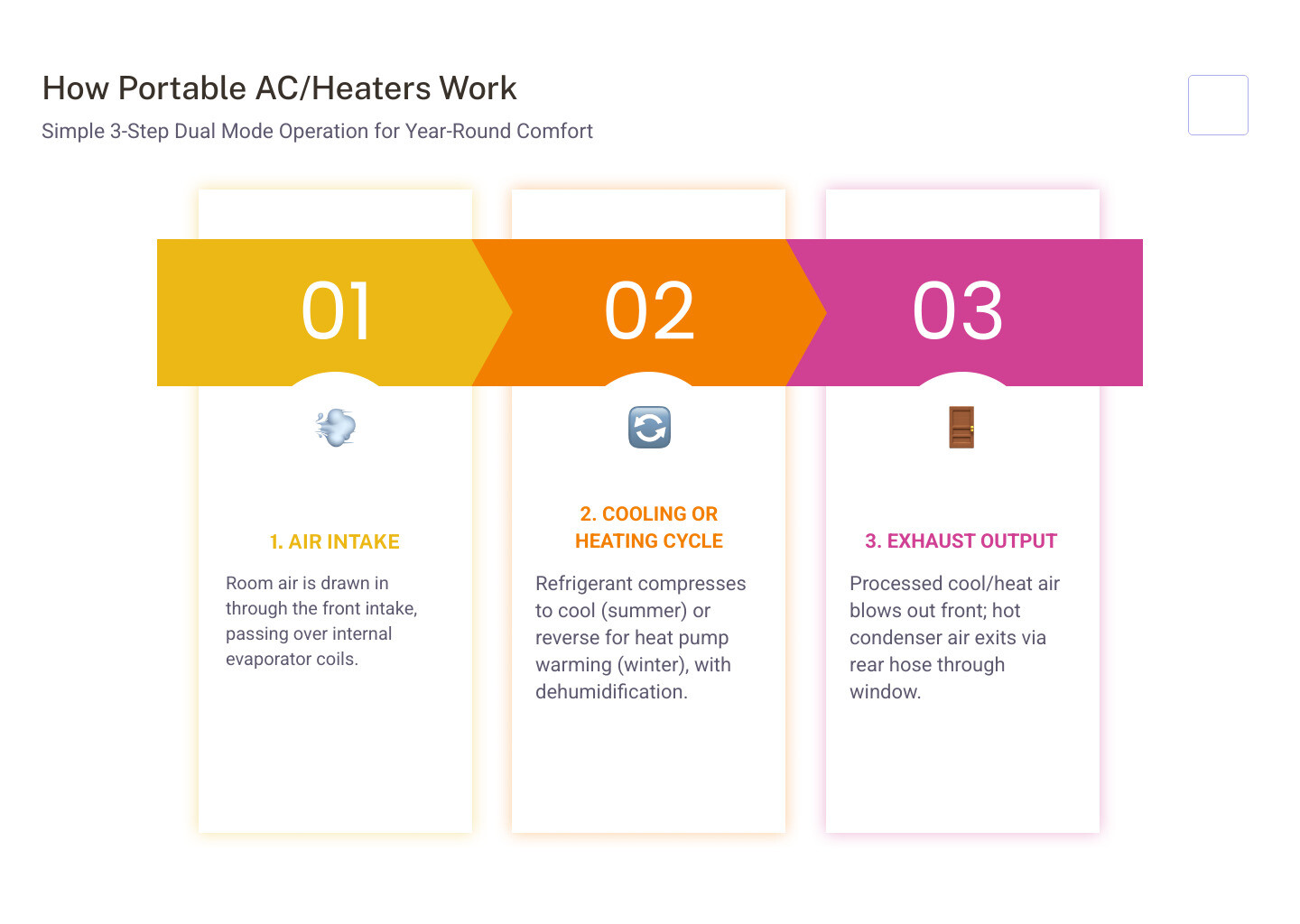
In the cooling mode, the unit extracts heat from your indoor air and vents it outside through a hose. In heating mode, the process is essentially reversed or supplemented to blow warm air into the room. It’s important to remember that these are designed for supplemental heat. If it’s -10°F in North Smithfield, a portable heater won’t replace your main furnace, but it will certainly take the edge off a drafty room.
For more details on professional-grade alternatives, you can check out the Commercial Cool Portable Air Conditioners listings to see current retail availability.
Smart Controls and Portability
Portability is the “P” in PAC (Portable Air Conditioner), and Commercial Cool doesn’t disappoint here. These units sit on four easy-roll casters, making it simple to move the unit from a conference room to an individual office as needed.
Other smart features include:
- 24-Hour Timer: Program the unit to turn on an hour before you arrive at the office.
- Sleep Mode: Gradually adjusts the temperature overnight for better comfort and energy savings.
- Auto-Evaporation: In most cooling conditions, the unit recycles the moisture it pulls from the air to cool the internal coils, meaning you don’t have to empty a water bucket constantly.
- 3 Fan Speeds: Allows you to balance noise levels with airflow needs.
Decoding BTU Ratings and Efficiency
If you’ve spent any time shopping for a commercial cool air conditioner heater, you’ve probably run into a confusing mess of acronyms: BTU, SACC, CEC, and ASHRAE. Let’s clear that up.
Historically, all portable ACs were rated using the ASHRAE standard. However, the Department of Energy (DOE) realized that portable units often lose some efficiency because the exhaust hose radiates heat back into the room. To give consumers a more “real-world” number, they introduced the SACC (Seasonally Adjusted Cooling Capacity) rating.
When you see a unit labeled as 14,000 BTU (ASHRAE) but 10,000 BTU (SACC), the 10,000 number is the one you should use for sizing. It’s a more honest reflection of how much cooling you’ll actually feel. For businesses looking for high-efficiency permanent solutions, we often point them toward systems like the DX3SEA Air Conditioner | Split System | Commercial HVAC | Daikin, which offers much higher SEER2 ratings than any portable unit can achieve.
Why BTU Ratings Matter for Your Space
Choosing the right BTU rating isn’t just about square footage. You also need to consider:
- Ceiling Height: High ceilings in a converted mill building in Mapleville mean more air to cool.
- Insulation: Poorly insulated spaces will require more BTUs to maintain temperature.
- Heat Load: Does the room have large south-facing windows? Do you have several computers running? These add to the “heat load.”
Getting the size wrong can lead to “short-cycling” (if the unit is too big) or constant running (if it’s too small), both of which will spike your electric bill. If you’re unsure about the long-term costs of your HVAC choices, take a look at our guide on Unpacking the Price Tag: Commercial AC Unit Replacement.
Portable Units vs. Central HVAC Systems
As much as we love the convenience of a commercial cool air conditioner heater, it’s important to know where they sit in the grand scheme of HVAC.
Portable units are “plug-and-play.” You vent them out a window, plug them into a standard 115V outlet, and you’re good to go. However, they are generally less efficient than central systems or ductless mini-splits. A central heat pump or a high-efficiency multi-zone system (like those from ACiQ or Panasonic) can offer SEER2 ratings of 20 or higher, whereas portable units usually hover much lower.
If you are a business owner in Smithfield, RI, looking for a permanent, high-efficiency solution, our Efficient and Reliable Commercial HVAC Services in Smithfield, RI can help you transition from noisy portable units to a seamless, quiet central system.
When to Choose a Portable Commercial Cool Air Conditioner Heater
Despite the efficiency gap, there are several scenarios where a portable unit is actually the best choice:
- Renters: If you don’t own the building, you can’t go knocking holes in the walls for a split system.
- Supplemental Cooling: If your central AC is working fine but your server room is still running at 85 degrees, a portable unit is a perfect “spot cooler.”
- Historic Buildings: In places like Stillwater or Georgiaville where historic preservation rules might prevent exterior modifications, a window-vented portable unit is a lifesaver.
For those considering a more permanent upgrade for their business, we recommend reading our Seamless Commercial AC & Heating Replacement: A Business Owner’s Guide.
Maintenance and Troubleshooting for Longevity
To keep your commercial cool air conditioner heater running efficiently for more than just one season, a little bit of TLC goes a long way.
- Clean the Filters: Most Commercial Cool units have “slide-out” filters. These should be rinsed with warm water and a mild detergent every two weeks during heavy use. Dust buildup is the #1 cause of reduced airflow and frozen coils.
- Check the Exhaust Hose: Ensure the hose is as short and straight as possible. Kinks in the hose restrict airflow and force the compressor to work harder, shortening its lifespan.
- Drainage: While these units are “no-drip” in most conditions, high humidity (common in Rhode Island summers!) might cause the internal tank to fill. If the unit shuts off and shows an “FT” (Full Tank) error code, you’ll need to use the lower drain plug to empty the water.
- Off-Season Storage: When the season ends, run the unit in “Fan” mode for a few hours to dry out the interior before storing it in a dry place.
For more professional maintenance tips, visit our Commercial AC & Heating service page.
Frequently Asked Questions
How do I install the window kit?
The window kit is designed for tool-free installation. It includes a slider bracket that expands to fit most standard double-hung or sliding windows. You simply fit the bracket into the window opening, close the window to secure it, and then “click” the exhaust hose into the bracket. It works for both horizontal and vertical window orientations.
Are these units energy efficient?
While they are convenient, portable units are generally less efficient than window units or mini-splits. Look for the DOE SACC rating to compare models. Using features like the 24-hour timer and the adjustable thermostat can help keep your power consumption in check.
Can I use the heater in extreme cold?
Most commercial cool air conditioner heater models use heat pump technology or electric resistance heat. They are excellent for “shoulder seasons” (fall and spring) or as supplemental heat. However, their efficiency drops significantly when outdoor temperatures fall below freezing. They are best used to warm up a specific room, not as the primary heat source for a whole building in a Rhode Island winter.
Conclusion
A commercial cool air conditioner heater is a versatile, cost-effective way to manage the micro-climate of your office or home. Whether you’re dealing with a “hot spot” in your Slaterville retail shop or you’re a renter in Johnston looking for year-round comfort, these units offer a practical solution without the need for a major construction project.
However, if you find yourself relying on three or four portable units just to keep your business running, it might be time to look at a more efficient, permanent HVAC solution. At Advanced Heating & Cooling, we’ve spent three decades providing honest, quality workmanship to our neighbors in Smithfield and the surrounding areas.
We offer free estimates and expert consultations to help you find the perfect balance between upfront cost and long-term energy savings. Ready to upgrade your comfort? Visit our Commercial AC & Heating page or contact us today to schedule a consultation. We’re here to make sure your business stays “Commercial Cool” all year long.