When Your Heat Goes Out: What to Know About Local Boiler Repairs
Local boiler repairs are services performed by licensed HVAC or heating technicians who diagnose and fix problems with your home’s boiler system — restoring heat, hot water, and comfort.
Here’s what most homeowners need to know, fast:
| Question | Quick Answer |
|---|---|
| When do I need a repair? | Strange noises, leaks, no heat, rising energy bills, or low pressure |
| Who should do the work? | A licensed, local HVAC technician (Gas Safe registered for gas boilers) |
| How much does it cost? | Roughly $100/hr on average; $150/hr+ for emergency calls |
| How quickly can someone come? | Many local companies offer same-day or 24/7 emergency service |
| Repair or replace? | If your boiler is over 15 years old and needs frequent fixes, replacement may cost less long-term |
Your boiler works quietly in the background — until it doesn’t. A cold morning with no heat, a puddle under the unit, or a bill that suddenly jumped for no clear reason — these are the moments that send homeowners searching for help fast.
The problem? Finding a trustworthy technician you can actually rely on isn’t always easy. Too many homeowners have experienced the frustration of a contractor who shows up late, gives a vague quote, or recommends an expensive replacement when a simple repair would do.
This guide cuts through that noise. You’ll learn how to spot the signs your boiler needs attention, what a professional repair visit actually involves, and how to choose someone you can trust — without getting oversold.
I’m Richard Marcello, President of Advanced Heating & Cooling in Smithfield, RI, with over 30 years of hands-on experience in local boiler repairs and heating systems across Rhode Island. I’ve built my company on straightforward advice and honest workmanship, and that’s exactly what this guide reflects.
Recognizing the Need for Local Boiler Repairs
Living in Smithfield, North Smithfield, or Johnston means dealing with winters that don’t mess around. When the temperature drops, your boiler becomes the most important appliance in your home. But how do you know if that “clunk” you heard is a minor quirk or a major cry for help?
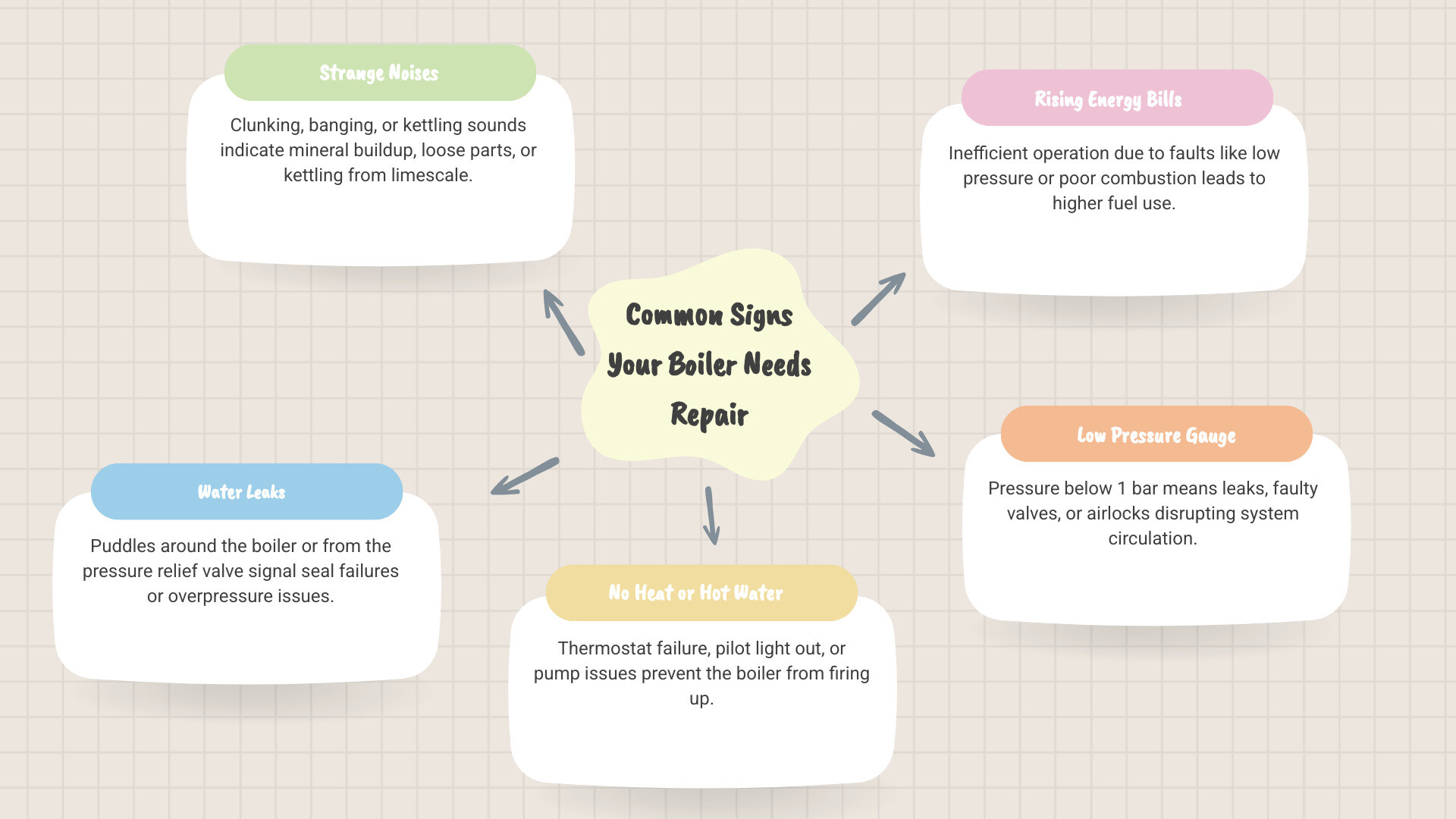
Recognizing the early warning signs of a failing system can save you from a freezing night and a much larger repair bill. Here are the most common indicators that it’s time to call for local boiler repairs:
Water Leaks and Drips
If you see a puddle around the base of your boiler, don’t ignore it. Leaks are often caused by a faulty internal component, such as a pressure valve or a pump seal. Over time, even a small drip can lead to significant corrosion and electrical damage. Furthermore, water around a gas-fired unit is a safety hazard that needs immediate professional attention.
Strange Noises (Kettling)
Boilers should run relatively quietly. If yours sounds like a giant tea kettle, it’s likely “kettling.” This happens when lime scale or sludge builds up on the boiler’s heat exchanger. This debris restricts water flow, causing the water to overheat and steam—much like a kettle on a stove. Other sounds to watch for include banging (often air in the system) or whistling.
Inconsistent Heating and Cold Spots
Are some rooms toasty while others feel like a walk-in freezer? This is a classic sign of a circulation issue. It could be a failing pump, a blocked pipe, or air trapped in your radiators. Before you assume the worst, check if your radiators need “bleeding” to release trapped air. If that doesn’t work, you’re likely looking at a mechanical failure that requires a pro.
Rising Energy Bills
If your gas or electric bill is climbing but your thermostat hasn’t moved, your boiler is losing efficiency. As components wear out or scale builds up, the system has to work twice as hard to produce the same amount of heat. Routine maintenance can often reverse this, but chronic high bills often signal it’s time for a diagnostic check.
The Yellow Flame
For gas boilers, the pilot light or burner flame should always be a crisp, clear blue. A yellow or orange flame is a major red flag. It indicates improper combustion and could be a sign that the unit is producing carbon monoxide—a colorless, odorless, and deadly gas. If you see a yellow flame, turn off the unit and call us immediately. For more detailed safety tips, check out our guide on Smithfield RI heating repair 101.
Common Boiler Problems and Professional Solutions
When we arrive at a home in Greenville or Esmond, we often see the same handful of culprits causing trouble. Modern boilers are complex, but most issues fall into a few predictable categories.
| Problem | Potential Cause | Professional Fix |
|---|---|---|
| No Heat or Hot Water | Failed motorized valve, broken diaphragm, or thermostat issue | Replace valve/diaphragm; recalibrate or replace thermostat |
| Low System Pressure | Water leak or faulty pressure relief valve | Locate and seal leak; replace pressure valve; repressurize system |
| Kettling / Banging | Limescale or sludge buildup on heat exchanger | Professional system flush (Powerflush); install magnetic filter |
| Pilot Light Goes Out | Broken thermocouple or draught in the flue | Replace thermocouple; clean pilot injector; inspect flue |
| Frozen Condensate Pipe | Extreme cold freezing the external drain pipe | Thaw pipe safely; insulate or reroute pipe to prevent refreezing |
Thermostat and Controls
Sometimes the boiler is fine, but the “brain” is confused. If your thermostat is old or miscalibrated, it won’t tell the boiler to kick on when it should. We often see motorized valves that have seized up, preventing hot water from reaching your radiators even when the boiler is firing perfectly.
Low Pressure and Leaks
Your boiler operates on a closed-loop system that requires a specific pressure range (usually 1.0 to 1.5 bar) to function. If the pressure drops, the system will often shut down as a safety precaution. While you can sometimes top up the pressure yourself using the filling loop, a constant drop in pressure almost always indicates a leak somewhere in the system.
Frozen Pipes
In the depths of a Rhode Island winter, the condensate pipe (which carries acidic water away from high-efficiency boilers) can freeze. When this happens, the water backs up into the boiler, causing it to shut down. This is a common reason for emergency heating repair during a cold snap. We solve this by safely thawing the pipe and adding insulation to prevent it from happening again.
What to Expect During a Professional Service Visit
We know that inviting a technician into your home can be stressful. At Advanced Heating & Cooling, we believe in transparency. When you call for local boiler repairs, you shouldn’t be left wondering what’s happening or how much it’s going to cost.
The Diagnostic Process for Local Boiler Repairs
A professional visit starts with a thorough investigation. We don’t just swap parts and hope for the best.
- Visual Inspection: We check the unit for signs of corrosion, leaks, or soot buildup.
- System Testing: We check the system pressure and test the safety controls to ensure the boiler will shut down correctly if a fault occurs.
- Combustion Analysis: For gas units, we use specialized tools to measure the ratio of gas to air, ensuring the boiler is burning cleanly and efficiently.
- Component Testing: We use multimeters to check electrical connections and sensors.
If you are looking for a certified professional, you can always Find a local boiler engineer through official registries to ensure they have the proper credentials for gas safety.
Quality Parts and Testing for Local Boiler Repairs
Once the problem is found, the repair begins. We prioritize using OEM (Original Equipment Manufacturer) parts. While “universal” parts are cheaper, they often don’t fit perfectly and can lead to premature failure.
After the repair, we don’t just pack up and leave. We perform:
- System Flushing: If we found sludge, we may recommend a flush to clean the internal pipes.
- Magnetic Filters: We often suggest installing a magnetic filter to catch metallic debris before it reaches your boiler’s sensitive parts.
- Performance Verification: We run the system through several cycles to ensure the thermostat is communicating correctly and the heat is distributing evenly across all zones of your home.
Repair vs. Replacement: When to Upgrade Your System
This is the question every homeowner dreads: “Is it worth fixing, or should I just get a new one?” As a company that has served the Smithfield area for 30+ years, we give you the same advice we’d give our own families.
The 15-Year Rule
Most modern boilers are designed to last between 15 and 20 years. If your unit is under 10 years old, a repair is almost always the right move. However, once a boiler hits the 15-year mark, parts become harder to find and more expensive. If you find yourself calling for local boiler repairs every single winter, those $300-$500 bills start to look like a down payment on a new, more efficient system.
Efficiency and Savings
Older boilers (non-condensing models) are often only 60% to 70% efficient. That means for every dollar you spend on fuel, 30 to 40 cents is literally going up the chimney. New high-efficiency condensing boilers can reach 95% efficiency or higher. In many cases, the energy savings alone can pay for the new unit over several years.
If you’re considering a total system change, you might also want to look into the pros and cons of heat pumps vs furnaces or boilers to see what fits your home’s layout best. To compare local options and reviews, you can also Hire the Best Local Boiler repair pros to see how different systems perform in our specific climate.
Frequently Asked Questions about Boiler Maintenance
How long do boilers usually last?
Generally, you can expect a well-maintained boiler to last 15 to 25 years. The specific lifespan depends on the fuel type (gas, oil, or electric) and how hard the system has to work. A boiler in a massive 5-bedroom home in Stillwater will likely wear out faster than one in a small condo in Georgiaville. The single biggest factor in longevity is the importance of regular heating maintenance. An annual tune-up can literally double the life of your system.
How much do typical repairs cost?
On average, HVAC technicians and plumbers charge around $100 per hour, with rates typically ranging from $45 to $200 depending on the complexity of the job.
- Trip Fees: Most companies charge a flat fee of $100–$350 just to come to the house.
- Emergency Rates: If your boiler dies at 2 AM on a Saturday, expect to pay an average of $150 per hour plus a higher trip fee.
- Parts: A simple thermocouple might cost $20, while a new heat exchanger can cost over $1,000.
How can I prevent future breakdowns?
The best way to avoid needing local boiler repairs is to be proactive:
- Annual Servicing: Have a pro look at it every autumn before the first freeze.
- Bleed Your Radiators: If they are cold at the top and hot at the bottom, there is air trapped inside. Bleeding them takes five minutes and improves efficiency.
- Check the Pressure: Keep an eye on the pressure gauge. If it’s too low, the boiler won’t fire.
- Chemical Inhibitors: Ask your technician about adding a chemical inhibitor to the water to prevent internal corrosion and sludge buildup.
Conclusion
At Advanced Heating & Cooling, we’ve spent three decades keeping our neighbors in Smithfield, RI, and the surrounding towns warm and cozy. We know that a broken boiler is more than just an inconvenience—it’s a disruption to your family’s life.
Whether you’re in Forestdale, Mapleville, or Woodville, our team is dedicated to providing honest, quality workmanship. We don’t believe in high-pressure sales tactics; we believe in solving your problem with the best possible technical solution at a fair price.
If your boiler is acting up, making strange noises, or simply hasn’t been serviced in a few years, don’t wait for the next blizzard to find out if it’s going to hold up. We offer free estimates and are always happy to chat about the best options for your home or business.
Ready to get your heating system back on track? Contact Advanced Heating & Cooling today to schedule your service or request a free estimate. Let us show you why 30+ years of experience makes all the difference.